

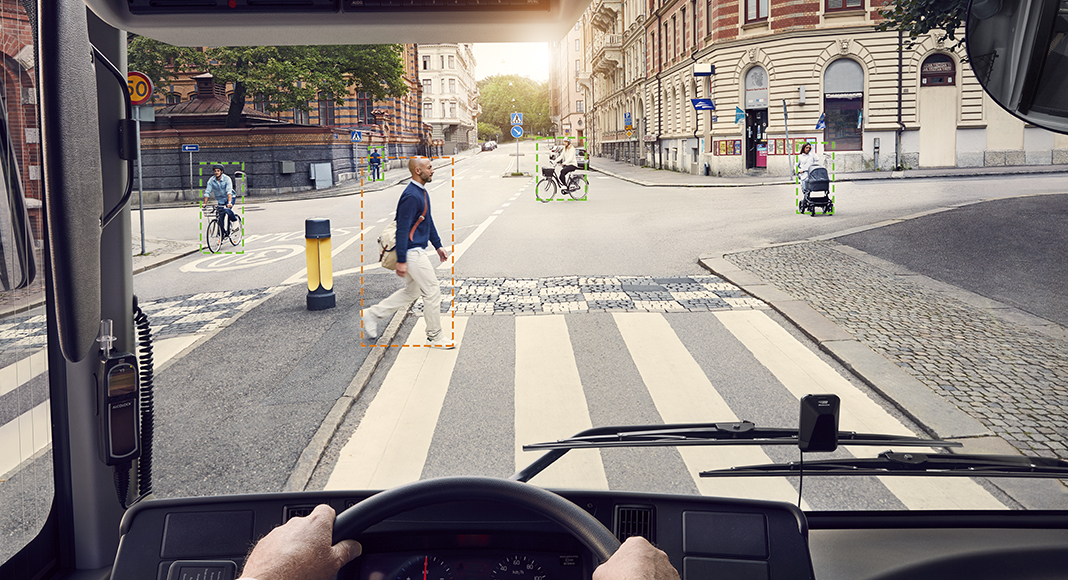
Volvo Buses has revealed details of a pedestrian and cyclist detection system, unique to the bus industry.
The system, launched at IAA Hanover, will be introduced on Volvo’s European city bus fleet in 2017.
“Accidents involving buses and unprotected road-users seldom occur, but when they do the consequences may be very serious. In order to minimise the risks, it is important that drivers and anyone moving around near buses – such as at bus stops and pedestrian crossings – pays close attention to the traffic. In this context the Pedestrian and Cyclist Detection System offers excellent support,” said Peter Danielsson, Director Vehicle Features and Safety at Volvo Buses.
The Pedestrian and Cyclist Detection System continuously monitors the bus’s vicinity using a camera. When unprotected road users are detected near the bus, it transmits a sound to warn other road users that the bus is approaching. At the same time, the driver is alerted via sound and light signals inside the vehicle. If there is an imminent risk of an incident, the bus’s horn is activated.
“Several of the components in our system are based on the same tried and tested technology found in many cars. But we are the only vehicle manufacturer to offer a solution that simultaneously notifies both driver and unprotected road-user,” said Mr Danielsson.
Volvo Buses’ introduction of this type of warning system is part of the company’s electromobility drive. As the proportion of electrified vehicles in urban traffic continues to grow, exhaust fumes and noise continue to disappear. At the same time, however, it is important to also eliminate any risks that might arise as the vehicles in the urban environment operate much more quietly.
“The bus can be heard – but without being disruptive. We’ve solved this problem by developing a synthetic background sound with a frequency range that is not perceived as disruptive. For instance, it does not penetrate windows with triple glazing, unlike the low-frequency noise made by a diesel engine.”