

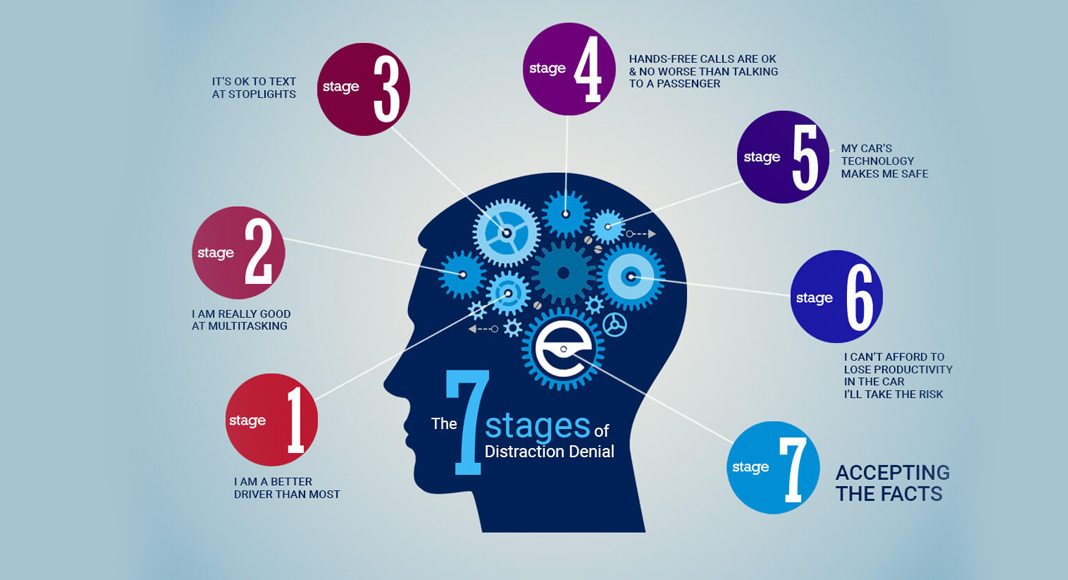
As part of its efforts to help drivers address distracted driving, eDriving has enlisted Paul Atchley, Ph.D. as its distracted driving behavioral science advisor. Atchley is a noted brain researcher and driver safety expert at the University of Kansas. Initial work with Atchley has led to the development of the Seven Stages of Distraction Denial.
“The Seven Stages of Distraction Denial helps drivers confront myths that fuel their own distracted driving demons,” said Celia Stokes, CEO of eDriving. “By knocking down these deceptions that we tell ourselves, we can honestly begin to change our own driving and put safety at the forefront.”
Here’s an abridged version of the eDriving Seven Stages of Distraction Denial:
Stage 1: I’m a better driver than most. Stage 2: I’m really good at multitasking. Stage 3: It’s OK to text at stoplights. Stage 4: Hands-free calls are OK and no worse than talking to a passenger. Stage 5: My car’s technology makes me safe. Stage 6: I can’t afford to lose productivity in the car or miss out on something. Stage 7: Acceptance: I accept the truth about distracted driving and am committed to breaking my bad habits.
eDriving’s new eDriving Distracted Driving Center, launched for Distracted Driving Awareness Month, includes a full version of the eDriving Seven Stages of Distraction Denial, with graphics, textual explanations, and video interviews with Atchley explaining each stage.
Distracted Driving Quiz – Two Eye-Opening Minutes
To help drivers assess where they are on the spectrum of distraction denial, eDriving has also launched a short Distracted Driving Quiz.
“Our mission is to build smart drivers, and that means confronting the American epidemic of distracted driving,” explained Stokes. “eDriving is uniquely positioned to address the challenge, and we’re taking it head on because it’s too big a problem to ignore. We have proven solutions based on cognitive science that have worked for the world’s most responsible companies and can work for any and every family.”
Dr. Atchley added: “The fact is we fool ourselves by thinking we understand the risks. And just knowing risk does not change behavior. Even though drivers consistently rate distracted driving as very risky, they do it anyway. Lack of driver attention is the most common cause of crashes, and it will only get worse if we do not collectively create a new norm.”